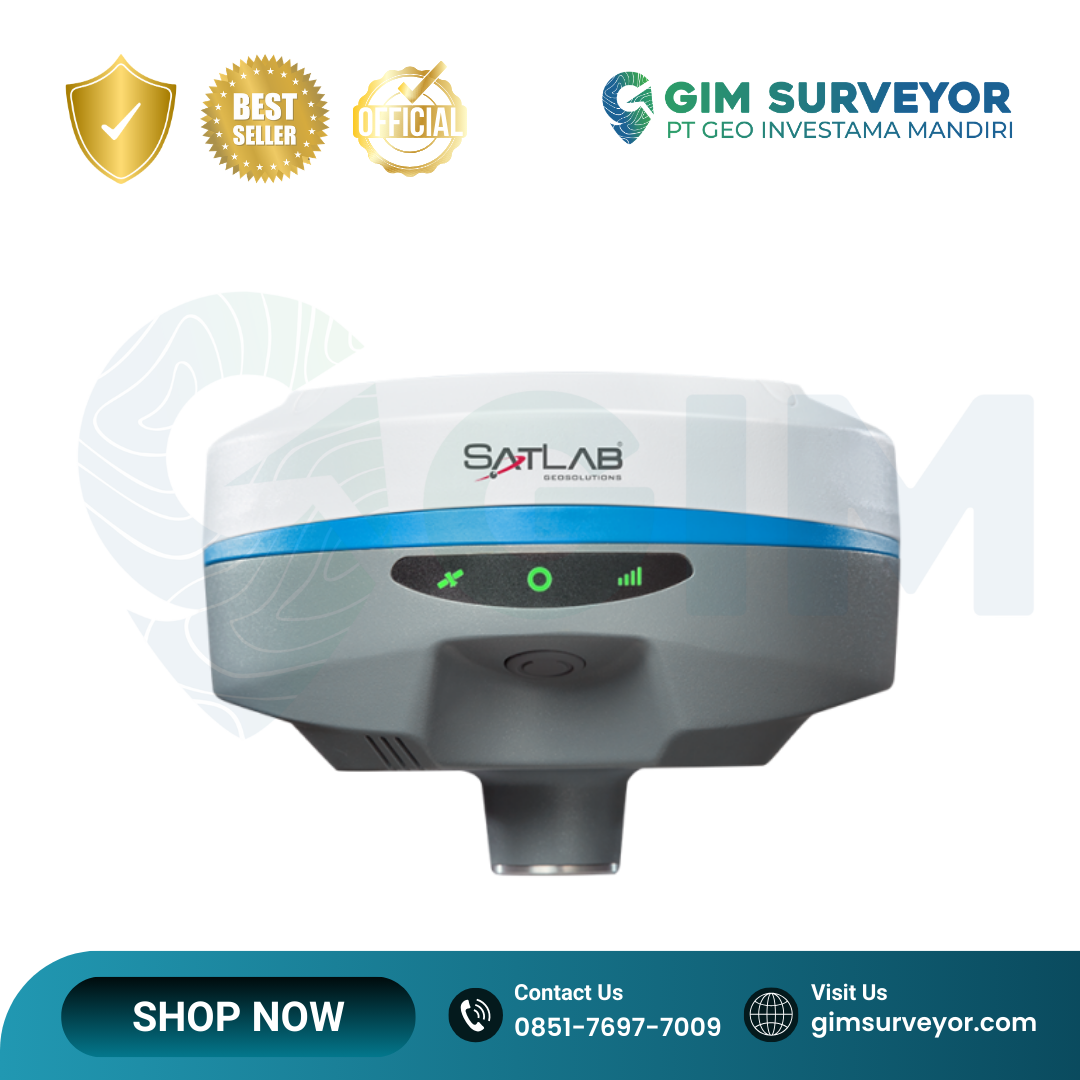
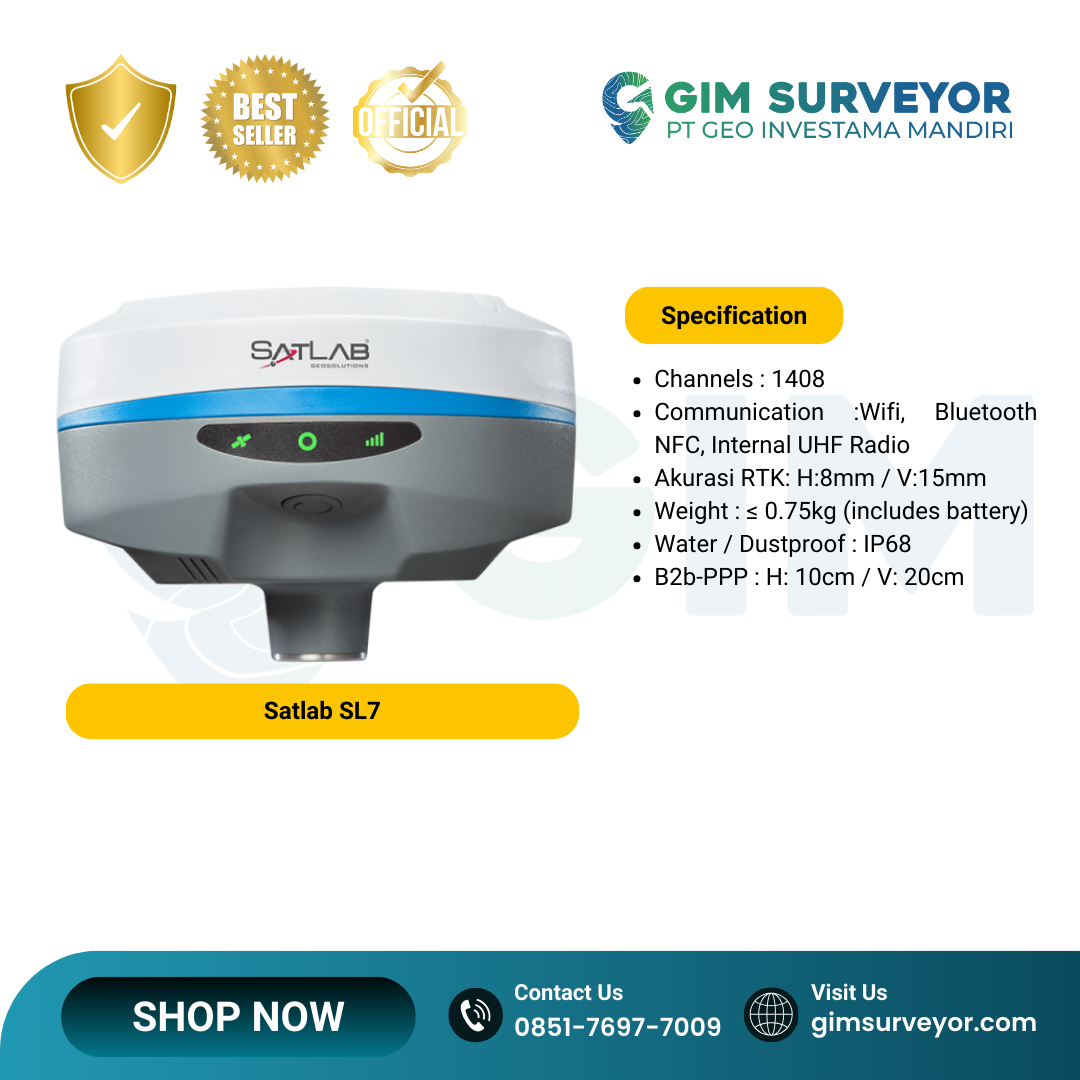
SatLab SL7 GNSS Receiver
Description
The SatLab SL7 GNSS Receiver is a compact and lightweight high-precision GNSS RTK receiver designed for professional surveying, mapping, and geospatial data collection. Equipped with an advanced GNSS chipset and a high-performance antenna, the SL7 provides stable centimeter-level positioning even in challenging environments such as urban areas, dense vegetation, or complex terrain.
The receiver supports simultaneous tracking of multiple satellite constellations including GPS, GLONASS, Galileo, and BeiDou, increasing satellite availability and improving positioning reliability. It features up to 1408 GNSS channels, ensuring robust signal tracking and strong resistance to interference.
One of the key innovations of the SL7 is its integrated HD starlight camera, which enables visual stakeout with Augmented Reality (AR) through the SatSurv Survey Software platform. This allows surveyors to locate target points visually in the real environment, improving efficiency compared to traditional stakeout methods.
The SL7 is also equipped with a 200 Hz IMU sensor, enabling tilt compensation up to 60° without requiring manual calibration. This allows accurate measurements even when the survey pole is tilted, significantly improving productivity in the field.
With its rugged design, lightweight body (approximately 750 g), and extended battery life of up to 24 hours, the SL7 provides excellent portability and reliability for long surveying sessions.
The receiver is ideal for various geospatial applications, including:
-
Land and cadastral surveying
-
Topographic mapping
-
Construction and engineering surveys
-
GIS data collection
-
UAV ground control point (GCP) surveys
-
Hydrographic surveys
-
Precision agriculture
Technical Specifications
GNSS Signal Tracking
-
Satellite systems: GPS, GLONASS, Galileo, BeiDou, QZSS, NavIC (IRNSS), SBAS
-
GNSS signals:
-
GPS: L1C/A, L1C, L2P(Y), L2C, L5
-
BeiDou: B1I, B2I, B3I, B1C, B2a, B2b
-
GLONASS: L1, L2, L3
-
Galileo: E1, E5a, E5b, E6
-
QZSS: L1, L2, L5, L6
-
-
Number of channels: 1408
Positioning Performance
Static Survey
-
Horizontal: 2.5 mm + 0.1 ppm RMS
-
Vertical: 3.5 mm + 0.4 ppm RMS
PPK / Stop-and-Go
-
Horizontal: 2.5 mm + 0.5 ppm RMS
-
Vertical: 5 mm + 0.5 ppm RMS
RTK Positioning
-
Horizontal: 8 mm + 1 ppm RMS
-
Vertical: 15 mm + 1 ppm RMS
Code Differential GNSS
-
Horizontal: ±0.25 m + 1 ppm RMS
-
Vertical: ±0.5 m + 1 ppm RMS
SBAS
-
Horizontal: 0.5 m
-
Vertical: 0.85 m
RTK Initialization
-
Initialization time: < 10 s
-
Reliability: > 99.9%
Time to First Fix (TTFF)
-
Cold start: < 45 s
-
Hot start: < 30 s
-
Signal re-acquisition: < 2 s
IMU and Visual Measurement
-
Built-in 200 Hz IMU sensor
-
Tilt compensation up to 60°
-
Automatic tilt calibration
-
Integrated HD starlight camera
-
AR visual stakeout support
Communication
-
Bluetooth
-
Wi-Fi
-
Internal UHF Radio (410–470 MHz)
-
Adjustable transmission power: 0.5 W / 1 W / 2 W
-
Radio range: typically 3–5 km, optimal 8–15 km
-
Network RTK support (NTRIP, VRS, FKP, MAC)
Data and Storage
-
Internal storage: 16 GB
-
Output format: NMEA-0183
-
Static data format: RINEX
-
Output rate: 1–20 Hz
-
RTK protocols: RTCM 2.x / RTCM 3.x
Physical Specifications
-
Weight: ≈ 750 g
-
Protection rating: IP68
-
Compact and rugged field design
Battery
-
Operating time: up to 24 hours
-
Energy-efficient GNSS chipset
✅ Key Advantages
-
Visual AR stakeout with integrated camera
-
1408-channel GNSS tracking for strong satellite reception
-
IMU tilt compensation up to 60°
-
Long 24-hour battery life
-
Lightweight 750 g portable design